
Based on the title and cover, you might think Heroes of Faerûn is a compendium of stat blocks for some of the Forgotten Realms’ most famous NPCs, but you’d be wrong: The book’s title actually refers to you, the players.
Rolling Epic Characters
One of the first things I ever read about player characters in Dungeons & Dragons was that they stood above ordinary folks in those imaginary worlds where D&D adventures take place. Nowhere is that stressed more strongly than in this latest rulebook. The designers of Dungeons & Dragons don’t want you to postpone greatness until level 15; they want you to create epic characters right from the start.
And once you’ve taken a closer look at this book, there does seem to be something epic about it. Some people might say it’s just another sourcebook, not unlike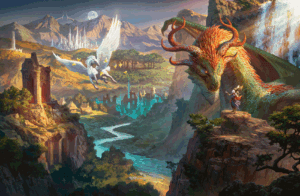 Tasha’s Cauldron of Everything and Xanathar’s Guide to Everything, but there is a big difference here; this one is written around a single theme: The Forgotten Realms, arguably the most popular world setting in D&D history. It’s also the first sourcebook for the D&D 2024 ruleset, adding new character creation options on top of those listed in the Player’s Handbook.
Heroes of Faerûn has a lot to offer to players who want to get the most out of their Forgotten Realms adventures. The book features several new subclasses (some updated for the 2024 rules), a large number of new player options (backgrounds, feats, etc.), and guides to the various regions, deities and factions of Faerûn.
A Book for Players, Not DMs
This is a book for players. If you’re a Dungeon Master (DM) and are envious of this new treat for players, don’t fret: Wizards of the Coast (WotC) has also released a companion volume, Adventures in Faerûn, for the DM’s eyes only.
A Tough Choice
It is always a hard choice when it comes to selecting the cover for these books. Once again, WotC offers this book in two different covers: the standard cover and the alternate cover. Both are very appealing. They look even better when you are holding the books in your hands. I usually favor the standard cover, and I did 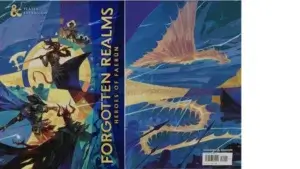 once again for this book. The standard cover feels more evocative; it feels like an homage to the heydey of the 1st and 2nd editions of D&D. The alternate cover still features outstanding artwork, and I was tempted to buy both.
Heroes of the D&D Multiverse Assemble
Both covers feature some of the same characters. There is a very “unifying” feel to the artworks, not unlike crossover comics, where superheroes from different books assemble for a common cause; they feature characters from several different corners of the D&D universe: There’s Karlach, the Tiefling barbarian with an Infernal Heart from the Baldur’s Gate 3 CRPG; Minsc (and Boo! Never forget Boo!), the beloved ranger who first appeared in the original Baldur’s Gate CRPG and one of the heroes of the Baldur’s Gate comic book series; Jarlaxle, the roguish dark elf from the D&D novels by R. A. Salvatore (creator of Drizzt Do’Urden); and Vajra Safahr, Waterdeep’s Blackstaff from the Dragon Heist 5e adventure.
Other D&D legends make an appearance in the book. There’s a full-page painting of Presto, Diana and Eric from the D&D animated series fighting a red dragon. Elminster, the Mage of Shadowdale, arguably the most famous NPC in Faerûn, is also there. Many say that Elminster is Ed Greenwood’s Forgotten Realms avatar. So, Elminster should be in every possible Forgotten Realms book.
I like this unifying movement in D&D. I appreciated the appearance of the characters from the animated television show in the recent Dungeons & Dragons film, Honor Among Thieves. I enjoyed that the adventure, Vecna: Eve of Ruin featured an ensemble of legendary D&D wizards (Mordenkainen, Tasha and Alustriel Silverhand). It makes the D&D multiverse seem more cohesive, where characters like Minsc (and Boo!) can meet Drizzt Do’Urden. It stimulates players’ and DMs’ imagination and makes that world that much more complex and enjoyable.
A Treasure Trove of Content
The book is fewer than 200 pages long, but I am amazed by how much material it contains. The book is not just a repository of Faerûn lore; it’s a guide to personalizing your character for the Forgotten Realms. If you are a fan of the Forgotten Realms, this is the book you’ve been waiting for since 5e came out. The Sword Coast Adventurer’s Guide published in 2015 did a great job introducing 5e players to the Forgotten Realms, and it’s still a valuable guide, but Heroes of Faerûn is a must for D&D 2024 players given all its character options designed for the new ruleset.
New Subclasses That Are Naturals for the Forgotten Realms
There are new subclasses, backgrounds and feats. They really bolster the ones already presented in the Player’s Handbook, and some will definitely become new favorites. They also feel custom-made for the Forgotten Realms.
There is the Scion of the Three subclass for rogues. I have a feeling it will be very popular. Scion is a good moniker for this subclass, as it draws power from the Dead Three: Bane, Myrkul and Bhaal. If you’ve been playing D&D for very long, or if you’ve read the many Forgotten Realms novels, these gods need no introduction. And new players will be fascinated by the lore behind this new subclass.
Spellfire Sorcery also makes a comeback. Spellfire has been thrown around a lot since the release of the Ed Greenwood novel of the same name. It’s been interesting to see how the concept has been woven into the game’s mechanics over the various editions of the game. I look forward to seeing this D&D 2024 version in action.
The Bladesinger is also back, officially for D&D 2024. I still call this class the “swordmage” after the title of the novel by Richard Baker published in 2008 that brought this specialty wizard class into the limelight. It remains, under 2024 rules, one of the most powerful spellcasting/melee weapon hybrid builds in the game, surpassing even the Hexblade since it was nerfed for the 2024 ruleset.
Custom-Made Backgrounds for the Forgotten Realms
Backgrounds have become even more important in D&D 2024, and the ones featured in this book will probably take precedence over the rest when rolling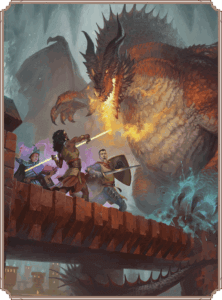 characters for a Forgotten Realms adventure.
They are broken into two groups: regional backgrounds and faction backgrounds. They are both great additions because they are tailor-made for the Forgotten Realms. I am particularly interested in the faction backgrounds. Players have always had the option of joining a faction. Factions have always been great as adventure hooks, but they have had very little (if any) impact on character build and game mechanics. The classic Forgotten Realms factions are now backgrounds that come with their own sets of benefits. This will be great news for players who’ve always wanted their chosen faction to play a bigger role in their character’s skillset. A faction will no longer just be a word scribbled down on a character sheet.
There are also backgrounds keyed to specific regions of the Realms, including Mythalkeeper, Rashemi Wanderer and Moonwell Pilgrim. As hard as it might have seen to select a background in the past, this new crop of backgrounds designed for The Realms will make it even harder to select one, because they all have great appeal. Luckily, the choice will be made easier by the class you elect to play. Some classes, backgrounds and factions go hand in hand. A Scion of the Three rogue would be a natural for the Zhentarim Mercenary background. I’m exciting for all the interesting new characters that will be created from the new rules in this book.
New Spellcasting Rules
An amazing new feature that spellcasters will love is the introduction of circle magic spellcasting. A Circle spell is cast by a group of spellcasters who collectively channel their magic into a single spell. It’s open to all spells that have a casting time of an action or one minute (or longer). It’s available to characters who have the Spellcasting or Pact Magic feature. The concept has been around for a long time in sword & sorcery and fantasy literature. It has also appeared in D&D novels. It’s interesting to see how they apply it to game mechanics for the 2024 ruleset. I believe this will be a favorite feature among spellcasters, and it will add a great storytelling element to adventuring.
There are also a number of new spells. I am particularly happy to see spells created by Elminster appear in this book. We haven’t seen much of Elminster in the last few years in D&D publications. The illustration where he casts his Effulgent Spheres spell is a welcome sight. There are quite a few spells here. Care obviously went into crafting these Realms-specific spells. They will definitely add a Forgotten Realms flavor to spellcasters’ arrays of spells.
Geography, Politics and the Faiths of The Realms
The Guide to the Realms section is a quick geopolitical treatise that will help players choose the country of origin of their character. I like how areas are separated into regions with mysterious names: Lands of Intrigue, Forgotten Lands, Arcane Empires and simply the Beyond.
Aglarond, Rashemen, Thay and Icewind Dale are all there. There’s enough info in here to fall in love with any one country or region. No matter how many times I’ve read about these countries in previous Forgotten Realms sourcebooks, it’s always a pleasure to rediscover them under the light of a new version of the game. I was happy to see attention given to countries far from the well-travelled Sword Coast of Faerûn, where most 5e adventures occurred.
The customary sections on the gods and factions of the Forgotten Realms are included. We’ve all read this info in the past, but it’s a good D&D 2024 refresher for OG players and an easy introduction for new players.
The Map
When I met Marion Zimmer Bradley (of Mists of Avalon fame), she said that if she ever saw another book with a map at the back, she was going to have a 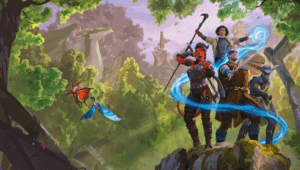 screaming fit! Well, this book has a map at the end, and when I saw it, I let out a joyful yelp, not in pain but in delight.
It’s not a one-pager. It’s not even a 2-pager. It’s a large-size, fold-out map; something that was hard to find during 5e and a welcome addition here. The last Forgotten Realms guidebook (the Sword Coast Adventurer’s Guide) also featured a map, but it did not even cover two pages. It was really hard on the eyes because of all the geographical information crammed into that small area. Players had to turn to third-party resources to find a large size map. It’s here now, in all its folded glory. I’m having mine framed and mounted on the wall of my gaming room.
In Conclusion
Heroes of Faerûn belongs on your D&D 2024 bookshelf alongside the new Player’s Handbook, Dungeon Master’s Guide and Monster Manual. This is a great Forgotten Realms book and the best D&D sourcebook in a long time. It is also a great companion to the Adventures in Faerûn book for DMs.


