
Jay Cormier had co-designed a board game based on one of his favorite comics. He had a publisher. But now, that publisher was going bankrupt.
Jay was already a successful freelance game designer. But publishing was never really part of the plan.
“For the longest time, whenever anyone asked me why don’t you just publish,” Jay says, “I was like, no interest. Zero interest in being a publisher. And I was totally happy. I love designing games.”
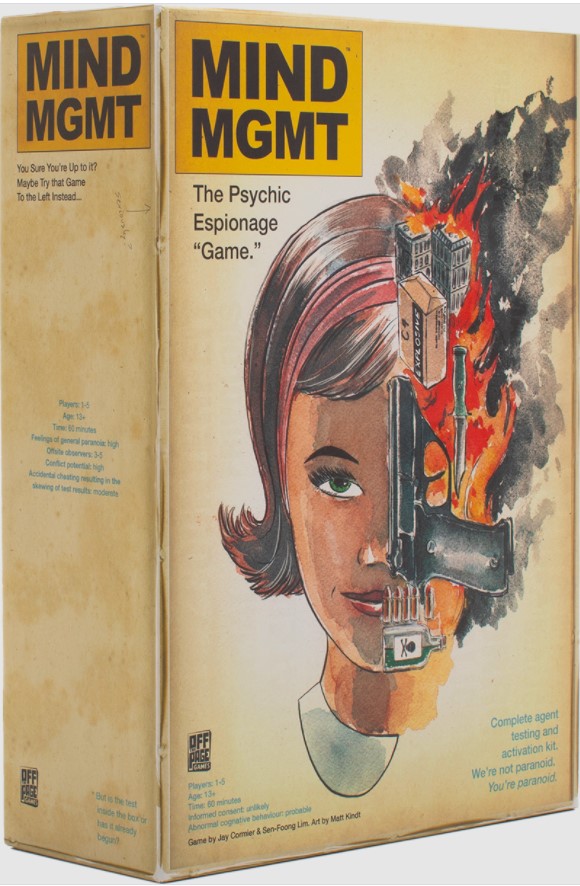 The game was Mind MGMT, based on Matt Kindt’s acclaimed psychic espionage comic series. And it was Kindt who suggested they simply publish it themselves.
“Here’s an opportunity to partner with one of my comic icon heroes and play in his world,” Jay reflects. “And I said, I guess I’m going to try it. And at the time I thought I might just make one game and that’s it. Just still be a freelance game designer.”
And Off the Page Games was born.
From Page to Table
From the beginning, Jay wanted to make sure his game company had a strong identity, and a name that meant something to him and to prospective fans.
“I thought, this is a comic book. Maybe all my games are going to be based off of indie comic books. Let’s try that,” Jay says.
Jay settled on a name with two meanings. It’s Off the Page because their designs come from the pages of a comic book. But also because the games jump off the page at you and come alive when they hit the table.
The Secret History of Mind MGMT
Off the Page owes its genesis to the Mind MGMT board game. But the seeds of that game were themselves planted half a decade before, during a chance meeting at the Gen Con game convention.
“It started with meeting Matt Kindt just as a random person at Gen Con,” Jay says. “We ended up playing board games together all night. And it was hilarious. It was lovely.”
That long night of gaming turned out to be the beginning of a five-year design journey. Alongside Jay for that process was Sen-Foong Lim, co-designer on several of Jay’s pre-Off the Page titles.
“And just offhandedly, he said man, it’d be so cool if there was a Mind MGMT game,” Jay says. “Sen and I perked up like, can we design that for you? And he said, would you? He was shocked and we were shocked.”
The night ended with a handshake deal and a plan to transform Matt’s comic into a tabletop game. Getting there took five years and a fundamental rethinking of what the game was actually about. Jay and Sen had worked together on licensed games before, but it proved challenging matching Mind MGMT’s unique theme with the right mechanics.
“It wasn’t until we actually realized, what is the experience we’re trying to get in this game?” Jay explains. “It was about paranoia and second guessing and doubting and being sneaky and this kind of like getting in your head.”
The breakthrough moment came when they realized what they were describing was a hidden movement game, a board game in which one player maneuvers against the others in secret, relying on limited information and deduction.
“From then on, boom, that was the game,” Jay says.
As the playtest groups got more familiar with the game, Jay and Sen added more and more to the base game. Repeat players were thrilled, but the game now risked being too overwhelming for newcomers. The solution was something Jay calls the SHIFT system.
“It comes with 14 sealed packages,” Jay says. “The loser of the game gets to open a sealed package and add these new little contents and rules to make their game better and make them better at it.”
Not only does the SHIFT system expand the game as you play it, it acts as a built-in equalizer for mismatched players. Instead of avoiding a more experienced opponent, a new player can simply say “I’ll play you, but I’m opening two of these first.”
The Tower and the Tree
Jay had a successful title and a brand new publishing company. And he already had something in mind for Off the Page’s next release. Called Skirmishes, it was co-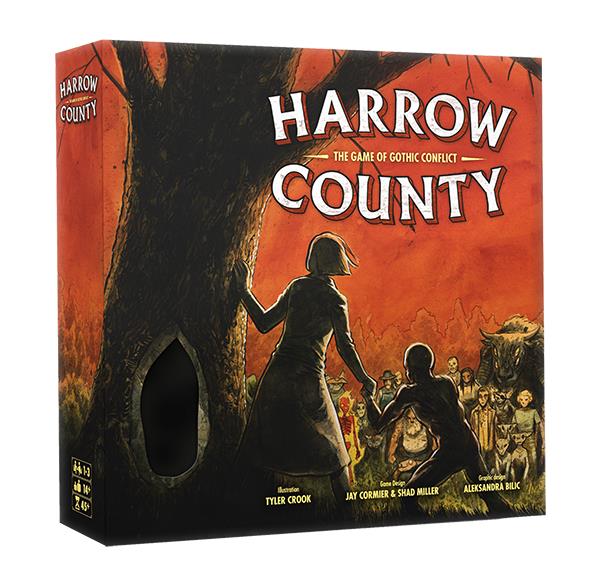 designed by Shad Miller. But Jay still needed a comic book.
Thanks in part to Matt Kindt, Jay pitched Skirmishes to Cullen Bunn and Tyler Crook, creators of the Southern gothic horror comic Harrow County. They said yes.
“And so we already had a game, but boy, oh boy, it was another year and a half of us developing from that game to turn it into Harrow County,” Jay explains.
One challenge was making sure combat in the board game matched the feel of the comic.
“We went with dice for the longest time. Dice, dice, dice,” Jay says. “And then the problem is there’s not a ton of combat in the game. So if you happen to get a bad roll, it really sucks.”
They balanced the dice mechanics, but that took away some of the thrill. Harrow County is a haunted setting, full of witches, monsters, and other “haints”. Jay wanted something appropriately emotional and thrilling.
The solution was a cube tower. That’s a special device in which players drop colored cubes into the top, which then tumble out the bottom like a dice tower. The exact number and color of cubes that fall out is uncertain, but somewhat controllable by the player. The tower helped create the tension that Jay was going for.
And Jay had an idea for the tower itself. In the Harrow County story, the main character is born out of a tree. A tree that was also the site of a witch’s execution.
“It’s got to have the tree on the cover,” Jay says. “And immediately I’m like, wait… tree on the cover, the cube tower. Can we include the cube tower into the box? And that’s what we were able to do. There’s an actual hole in the top and the front of the box. It was the best solution for combat. It made it thrilling and exciting, but fair. And the table presence has been amazing.”
Grendel
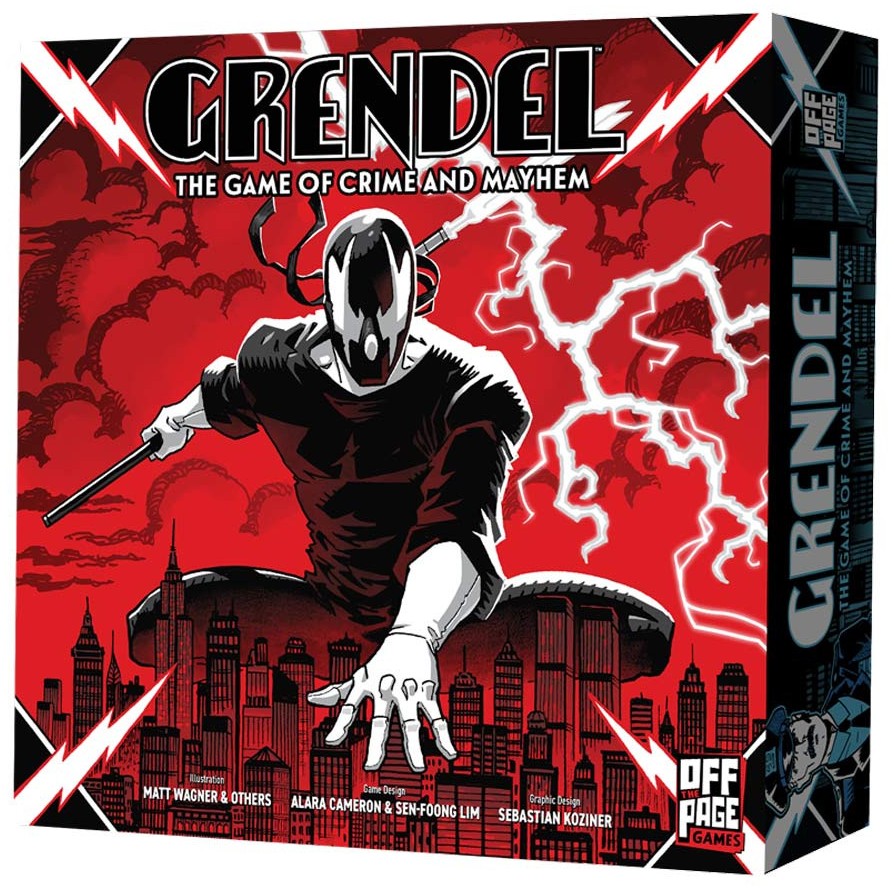 Every Off the Page game has its own origin story. For Grendel, the comic license came to them.
“Matt Wagner, the creator of Grendel, emailed me out of the blue asking if I could make a game based on Grendel,” Jay says. “Which, if you know anything about comics, Grendel’s a pretty seminal comic.”
In publication since 1982, Grendel is an influential series. Jay imagined it as a one-versus-one-versus-many game. When he pitched the concept to Sen-Foong Lim, Jay found that Sen already had a game he thought might fit the bill.
“Sen said he and Alara Cameron designed a game called Aliens versus Predator versus Marines, and it never got picked up. Maybe it could fit,” Jay recalls.
The final game is a four-faction asymmetrical game, pitting Grendel versus Argent versus the Mob versus the Police. Grendel became the first game Jay published that he didn’t design.
“But I helped develop the hell out of it,” Jay says.
Ultimately, Jay sees Grendel as a validation of his approach to adapting licensed properties.
“For me, not only does it have to be a good game on its own, it has to obviously do such a good job to represent the IP and the brand for three reasons. One for the fans, two for the IP holder, and three for future comic book creators looking at my games and going…these people know what they’re doing. They have so much passion for the source material. They’re doing it right.”
Designer and Publisher
Jay’s graphic designer has a standing complaint. Jay is a game designer first and publisher second.
“I get real energized from learning new things and that keeps me going,” he explains. “How am I going to do this? I don’t know. Let’s go figure it out, let’s start doing it.”
Jay finds that publishing has opened up new creative territory. But old habits die hard, and his team knows it.
“My graphic designer says in other companies, once a game is done, it’s done. You’ve got to put the game design hat down,” Jay explains. “But I think that’s an advantage for me because, I mean, it does make the game better by tweaking here and there.”
For Jay, every game Off the Page releases is an argument for the idea that the best board game adaptations earn their license. Their growing catalog, and the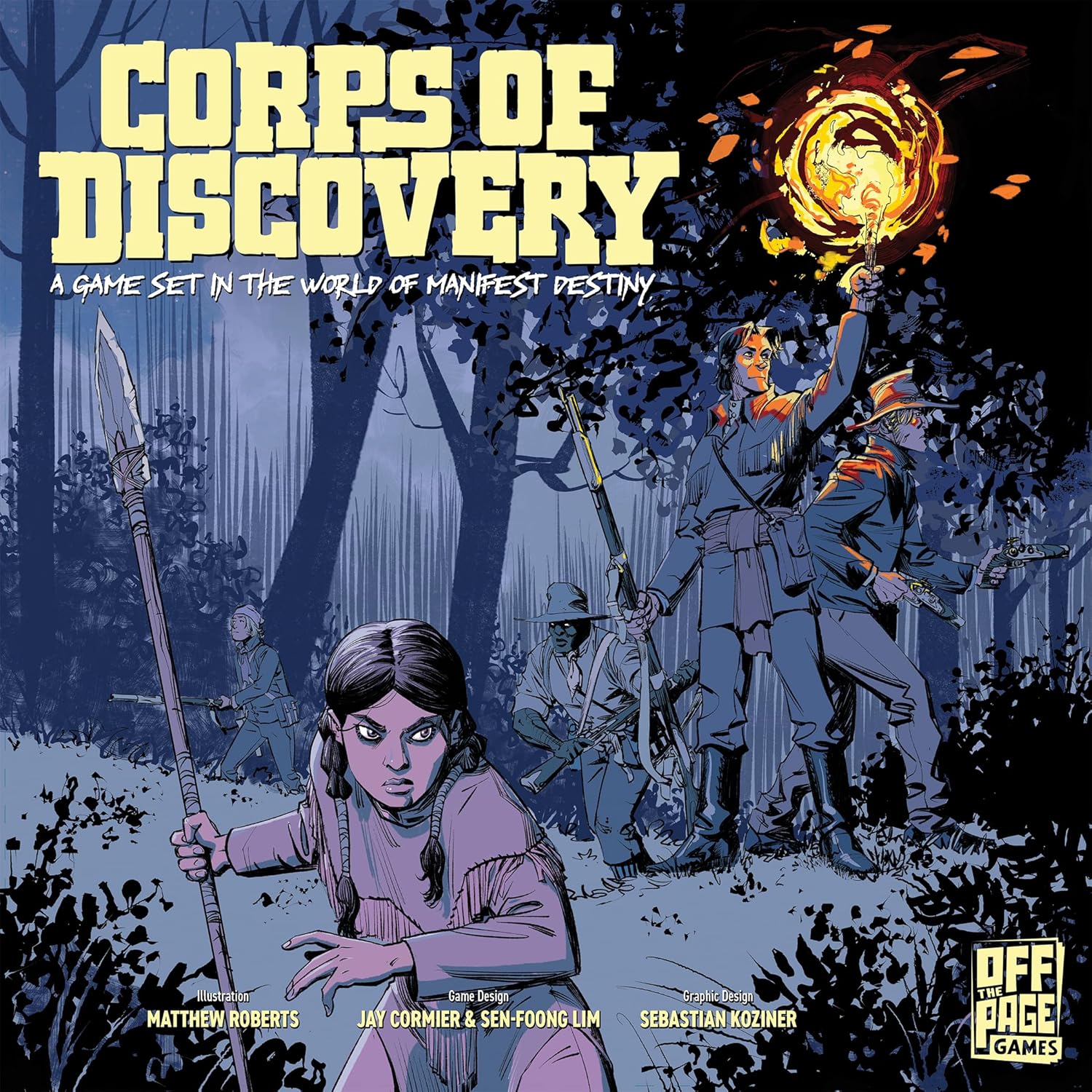 occasional unsolicited email from a comics legend, suggests the argument is landing.
A Few Questions with Jay Cormier, owner of Off the Page Games.
Tell me a little about how Off the Page Games as a company. How is it structured?
It’s just me as the owner. And then I’ve grown to include a full-time graphic designer and a full-time man of many hats. I call him my right hand man, but he does logistics, business-to-business sales, customer service, and social media. His name is Joe McNamara.
You’ve built your games around creator-owned comics. It’s a very unique focus. Was there something that drew you to that particular corner of the comics world?
It is definitely what I love. I’ve collected comics my entire life and they’ve been mostly creator-owned type stuff. Indie type stuff. There’s definitely some more popular stuff, but I never got into the superhero comics. So it’s always these off the beaten path type comics that I’ve collected. And so that’s my world.
What does the game let you do with a story that the source material can’t just by itself?
One of my caveats is, it’s got to be a good game first and foremost, even to people who have never heard of the source material. And so, and it’s got to be replayable. It’s probably a lot easier to represent a narrative thing like a comic book in a game by making it a one-time narrative kind of experience like an escape room type thing or an RPG or something like that. But I’m interested in how we can make this replayable. So I’m trying to find the essence, the experience.
So far, we’re three for three, and I’m going to say 4 for four once Grendel hits retail.
Do the constraints of adapting a property give you a creative advantage?
I think so. It’s like you’ve heard the phrase that constraint is the mother of invention. And it’s so true in board games. If you say to somebody, “hey, design a game, anything you want,” that’s the hardest thing you can do. But if you say “hey, design a game that can only use 12 cards and the theme is zombies,” I’m off to the races. It really motivates you.
If somebody wanted to understand what Off the Page Games is all about, is there a particular title you’d point them to first?
I think Mind MGMT has the most, I don’t want to say passion. Psychic espionage is the theme, and there’s so much psychic espionage stuff in the game, like hidden codes, red / blue messages that you need a filter that it comes with to read. There are 10 secret messages hidden in the art of the components. And if you find them, you go to a specific website listed in the rule book, type that code in, and it’ll give you a brand new card that you can print out and sleeve and add to your game.
You clearly have a passion for game design as a concept. How much time are you putting into just fiddling with games?
All the time. I’ve been teaching game design at Vancouver Film School for over 12 years. I have my own other company called Fail Faster, which is all about helping game designers be better. So one of the things that started with Fail Faster was this Fail Faster playtesting journal, which is a journal that helps you keep track of your playtest notes. And so that’s just something that’s going on. Plus there’s an online training academy that I’ve started with Fail Faster. And another thing called Design Your Destiny, a product that came out this year, which is a storybook with games in the book that you play. The games are all broken and it guides you on ways you can fix the games. That’s a great way for kids and older teenagers as well to get into game design and learn a bit more about the decisions that are part of making games. So yeah, game design is what I’m all about.
Is there anything else that you’d like to add?
I created a YouTube series called How to Start a Board Game Company. It’s on the Off the Page Games YouTube channel. I’ve never run a company before. But I made a video every week about how I was creating a board game company.
And again, it’s just part of me, like the Fail Faster thing, being transparent. Trying to help out, help the community, and share my journey and my process through all the rights and wrongs. I’ve always loved being transparent and showing people where we’re at. I think it’s very effective, especially in the crowdfunding kind of Kickstarter world where you’re very transparent with backers, letting them know where you’re at in the process. What’s happening, keep people apprised. I think that’s worked out for us really well.
Thank you very much for your time!


