
There’s something about Leder Games’ Root that immediately draws the eye. From the woodland creatures featured on the box cover, to the wonderful wooden cats, birds, mice, and raccoon meeples inside, Root presents something quite charming. Perhaps even cute.
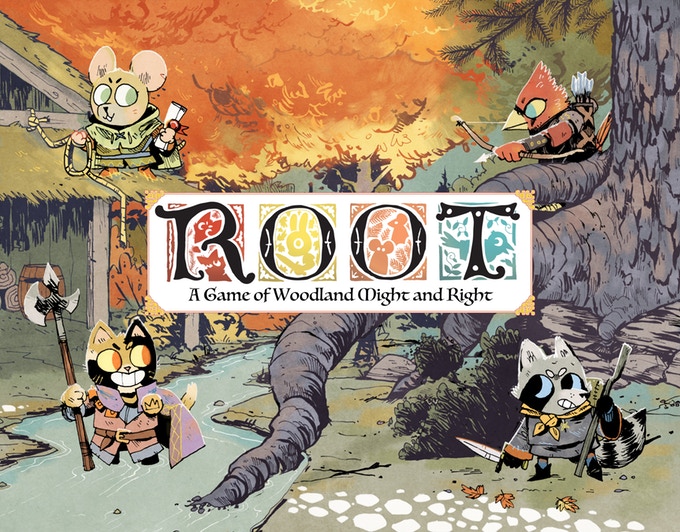 But there’s also something fierce lurking beneath that pleasant exterior. The gentle forest printed on the gameboard is a battlefield. The gameplay is different from faction to faction, and winning demands strong tactics. A game of Root can be brutal. Those adorable cats are carrying halberds. That raccoon has a knife.
We spoke with Liz Davidson, Creative Director at Leder Games, about the philosophy behind that contrast, and what it means to make games that are serious without taking themselves too seriously.
Creatures and Counterinsurgency
Root is a two to four player asymmetric strategy game published by Leder Games in 2018. Sharing its mechanical DNA with historical wargames, one of Root’s most direct influences is a series of games known as the COIN series. Created by publisher GMT, COIN games (short for COunter INsurgency) are all about guerilla tactics and warring factions that aren’t necessarily balanced in size or resources. Root takes those same traits and transports them from the battlefields of history to a forest realm contested by four opposing animal factions. It’s insurgents and imperials, played between mice and birds, and it’s deliberately designed to bring an intense wargame experience to a broad audience.
“I think that contrast is essential to the Leder identity, which combines serious gameplay with a sense of fun,” Liz says. “That is a model we want to continue to follow: substantive gameplay with broad visual appeal.”
Root certainly has that broad visual appeal, and it’s far from alone in the Leder Games catalog.
Whimsy With Teeth
In Vast: The Mysterious Manor, a brave paladin hunts the giant spider while skeletons stalk from the shadows. The warlock plots to control key pieces, while the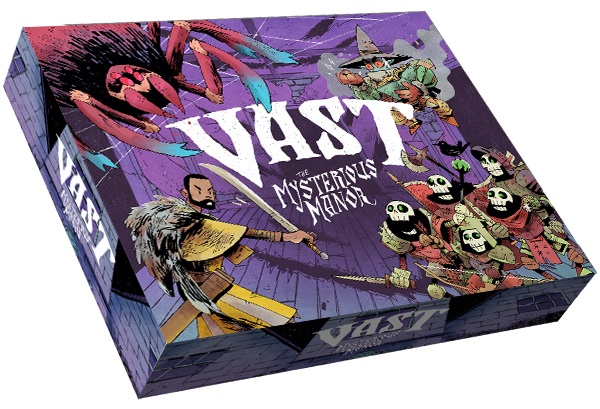 manor tries to trap everyone else inside. The contrast between hunter and hunted, with one player even taking on the unusual role of the manor itself, is pure Leder Games.
In Ahoy, Leder takes the faction play to the high seas. Swashbuckling sharks compete against an alliance of undersea creatures in a battle for fame and fortune. Players try to deliver cargo and vie for control of lucrative shipping lanes, balancing plunder and strategy in a game with a breezy tone and sharp play.
While themes and mechanics vary between different games, there is a consistent identity among Leder Games’ titles. Liz credits the studio’s close-knit creative team with maintaining that consistency across such varied projects.
“We are very much on the same creative page,” she says. “We also select games according to consistent internal criteria, so that even very different games express a lot of the same principles: they are mechanically interesting, thematic, and a little weird. Which is exactly how we like it.”
That shared creative vision is also supported by something relatively unusual among small game publishers: a fully staffed, full-time team.
“Having full-time staff means that our creative team has the support and stability needed to fully focus on our work together and on the games we create,” Liz says. “This ultimately enables us to spend more time fully focused on our games, helps us support them longer, and leads to better games on the whole.”
Asymmetry…and Beyond
Asymmetrical design runs deep in the Leder Games catalog. According to Liz, this kind of design goes right back to the very beginning.
“While asymmetry is not all we do, the studio has been drawn to it in part because Vast, the game that first launched our company, was an asymmetric game and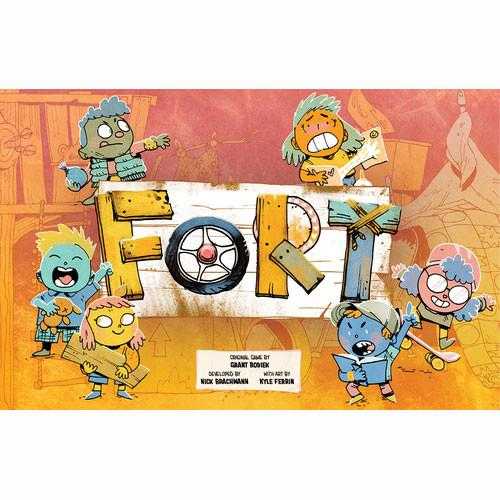 offered a fascinating design space to explore,” Liz explains. “At Leder, we love games with a lot of story and with a sense of fun, and asymmetry is an incredible tool for generating stories that feel fresh game after game.”
One title that doesn’t follow the asymmetrical model is Fort. This deck-building game is about kids competing to build the best fort, collecting pizza and toys along the way. The twist is that cards you don’t use go into a shared pool that other players can draft from. Sharing, it turns out, has strategic consequences.
Upcoming Games
Next on the horizon for Leder Games is Kart, a game about kids building and racing homemade soapbox carts. Liz explains how Kart’s theme of a downhill race informs the way it plays on the table.
“As gravity pulls you along, you speed up, which means you can’t steer quite so well…and chaos inevitably ensues.”
For Liz, Kart also represents a real achievement for a long-time team member, the game’s designer Alita Robertson.
“This is her first design, but she’s been at Leder since she was an intern,” Liz says. “Watching her create and get excited about her own project has been incredible.”
Another future project is an upcoming cooperative dexterity game by designer Taylor Shuss. In this game, players take on the role of mechs trying to protect their city from the ravages of a giant monster.
“And you have to do it by flicking your weapon cubes or your player token at them!” Liz says. “My stomach hurts from laughing every time I play it, and I can’t wait for everyone else to experience that joy.”
From raccoons with knives to mechs fighting monsters, Leder Games knows what it wants to make, and why it’s worth making. You can read the rest of our conversation with Liz Davidson below.
Could you tell me a bit about your role at Leder Games, and how community feedback shape the company’s decisions?
I am the Creative Director, which means I am responsible for setting our schedule, for finding great designs, and especially for promoting excellent designs from Leder Games staff. Community feedback matters a lot to us! We value our fanbase and love to show them what’s going on in the studio even from very early stages.
How did Leder Games first come together, and what does the company look like today? Who are the key people behind the scenes?
When it comes to key people, we are a small enough team that everyone is key; we have a talented creative team, as well as incredible people on the operational side. If you’re looking for our most “key” person, that would be Patrick Leder, our owner and founder. Our Executive Director is Johnny Dale, who oversees all day-to-day operations. And the person who scouts out games and helps them grow, is me, the Creative Director.
What makes a Leder Games title feel like a Leder Games title?
I think Leder Games do a few things that make them feel particularly “Leder-y.” We are always aiming for a clear theme, emergent narrative, a game worth playing many times over, and a sense of whimsy. Root, after all, is a very mean game and its factions have serious historical underpinnings…but it’s also a game about adorable woodland creatures.
Leder Games often talks about developing art, mechanics, and product design holistically. What does that look like in practice during development?
Although we take some games from external designers, our games develop their special flavor because we work on them intensively inside the studio. Our creative team is highly cohesive, with designers and developers working hand-in-hand with graphic designers and then artists to create a game that looks and feels just right.
How do playtesting, conventions, and fan feedback influence development at Leder Games?
We are deeply grateful for our Woodland Warriors server on Discord, and especially for the fans who playtest with us online and in person while our games are in various stages of development. Our testers are crucial to the process and we take feedback from them at every stage, including the later stages, when we take volunteers to do usability testing for our rulebooks.
Leder Games titles often receive expansions and long-term support. How do you decide when to expand a game versus moving on to something new?
We usually plan at least one expansion for every game, even if it’s only a small one. If our fans love a game, we want to have a little extra something to give them, and we want to make games that have longer lives than a single printing. But we also try to keep new games coming in, especially if one of our staff developers feels inspired.


